I Was A Delegate in 2008. The Libertarian Party is About to Repeat It
What the party’s February 2028 convention invites and the 2008 lesson it should remember
JAKE PORTER
Disclosure: I manage Jo Jorgensen’s exploratory campaign for the 2028 Libertarian presidential nomination. This is analysis, not campaign material.
Rand Paul told Newsmax on September 23 that he’s considering a 2028 presidential run and will weigh the midterms before deciding. Libertarian leaning Thomas Massie’s name circulates as a potential Republican contender. And the Libertarian Party (LP), which locked in a February 2028 nominating convention in El Paso, Texas, has inadvertently built the perfect scenario for chaos. I know, because I was a delegate in 2008 when we were saved from a similar situation by having a convention in May after most of the primaries were over.
Jake Porter’s Analysis & Investigations is a reader-supported publication. To receive new posts and support my work, consider becoming a free or paid subscriber.
The February Trap
In June 2025, then Libertarian National Committee (LNC) Chair Steven Nekhaila publicly considered moving the 2028 convention to February, arguing that it would give the party a longer ballot-access runway and grant the Presidential ticket more time to campaign for the general election. This proposal has been discussed by party delegates for years. In fact, once upon a time the party used to nominate the candidates the prior year to the election.
By October 2025, the LNC issued its venue request with a tentative date of February 2028. In February 2026, the committee voted 9-8 to hold the 2028 convention in El Paso, Texas and with that vote the February window was locked in.
The ballot-access logic is real. An earlier nomination does mean more time for petitioning and more time for fundraising.
But consider what February means. The Libertarian Party will choose our Presidential nominee while the major parties are just getting started with caucuses and primaries. The delegates in El Paso won’t be picking a nominee for the race as it is. They will be betting on the race as it might become. That is the trap. And it’s already being discussed in the open by people who endorsed Donald Trump at the expense of the LP in 2024.
2008: The Rehearsal
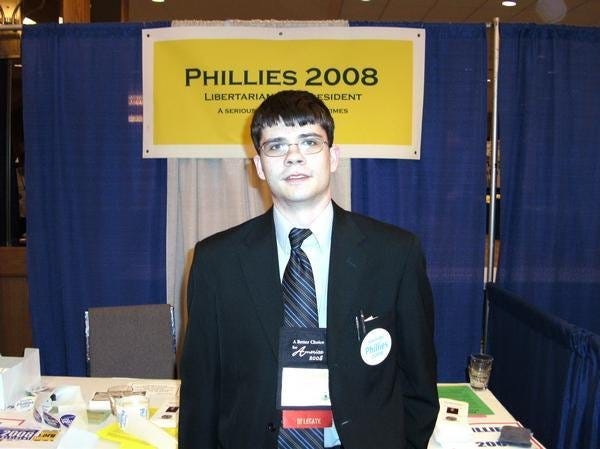
The author at the Phillies 2008 booth at the Libertarian National Convention in Denver. Photo Credit to the late Mike Bozarth (MO)
When Ron Paul announced his Republican presidential bid in 2007, the Libertarian Party didn’t just watch it happen. It emptied out. Members resigned to register as Republicans so they could caucus for him. I was in college in Iowa at the time, a caucus state, and I watched it happen up close.
LP presidential candidates started being told: “Why are you running against Ron Paul? You should just drop out and nominate Ron Paul.” While Paul could have waltzed right in and won the nomination on the first ballot, he wasn’t wanting the nomination in the first place.
There was even a small movement to not run an LP presidential candidate at all, to clear the field for Paul. It never killed the nomination, but it slowed everything down, and it may be part of why the field settled so late, with Mary Ruwart and Bob Barr entering when they did.
Then the national committee, if memory serves me, voted to use our phone operation to support Paul. I thought it was a conflict of interest at the time. Saying so out loud was treated by some as heresy. You did not dare criticize Ron Paul in Libertarian circles in 2008 without angering a lot of people within the party. Paul was just that popular.
This isn’t an attack on Ron Paul or a suggestion that libertarians shouldn’t have supported him. It was the job of the party to take the enthusiasm Paul generated and turn it into massive support for the LP. There were some missteps by the party, but at the end of the day I would argue Paul was ultimately a huge net benefit for the LP. That said, I won’t pretend that moving our convention up before the second Super Tuesday in 2008 wouldn’t have caused havoc on the party.
Denver-The LP National Convention (May 22-May 26, 2008)
By the time delegates arrived at the convention, the Paul campaign was basically over. Paul couldn’t win the Republican nomination and the delegates knew it. The “don’t run anyone” effort evaporated, and the convention did what conventions do: it nominated someone. Former Congressman Bob Barr won.
During the cycle I’d been chief of staff to George Phillies, one of Barr’s rivals for the nomination. After Denver, I became Barr’s Iowa coordinator for the general election. I saw the convention fight from the inside of one camp and the aftermath from the inside of the other.
What happened next told you everything about the tensions underneath. Paul wouldn’t endorse Barr. Instead he invited the minor-party candidates to a joint press conference and Barr didn’t attend. Barr’s people took the endorsement of all candidates as a snub and Paul’s people took Barr’s lack of attendance as a snub.
“The strongest message can be sent by rejecting the two-party system, which in reality is a one-party system with no possible chance for the changes to occur which are necessary to solve our economic and foreign policy problems. This can be accomplished by voting for one of the non-establishment principled candidates — Baldwin, Barr, McKinney, Nader, and possibly others.”
“I’m not interested in third parties getting the most possible votes. I’m interested in Bob Barr as the nominee for the Libertarian Party getting the most possible votes,” Barr said at a separate news conference in the same building less than an hour after Paul’s endorsement.
On the same day, Barr offered the Libertarian vice presidential spot to Paul. The response from Congressman Paul’s spokesman, Jesse Benton was that “Dr. Paul has zero interest in that.”
In September, Paul responded to the decision by Barr not to attend to settle on a single endorsement of Constitution Party nominee Chuck Baldwin.
After Paul
Some of Paul’s people came back to the LP. Some never did. Some of them are MAGA now. The energy that Paul built didn’t belong to the party. It belonged to Paul, and when he was done with it, it scattered in many directions. It came back stronger in 2012, which outperformed 2008 by every measure. But 2012 was Paul’s campaign, not the LP’s.
Why 2028 Is Different

The author with Rand Paul ahead of the 2016 Iowa caucuses.
Here’s what the nostalgia merchants leave out: 2028 isn’t 2008. Rand Paul is not Ron Paul.
However you rank the Paul’s as legislators, Rand doesn’t command the devotion inside the party that his father did in 2008. The “just nominate Paul” energy isn’t there for him the same way. And many of the people who lived through 2008 are gone. Many left the party. Many have died. The delegates who will walk into El Paso in February 2028 are a different delegation at a different point in American history, fighting over a different party and they’ll be doing it months earlier, before the Republican field has resolved, placing bets on a race they can’t see yet.
Congressman Thomas Massie is more like Ron Paul in 2008 to the LP. He has similar popularity within the party delegate base.
The Plan in the Open
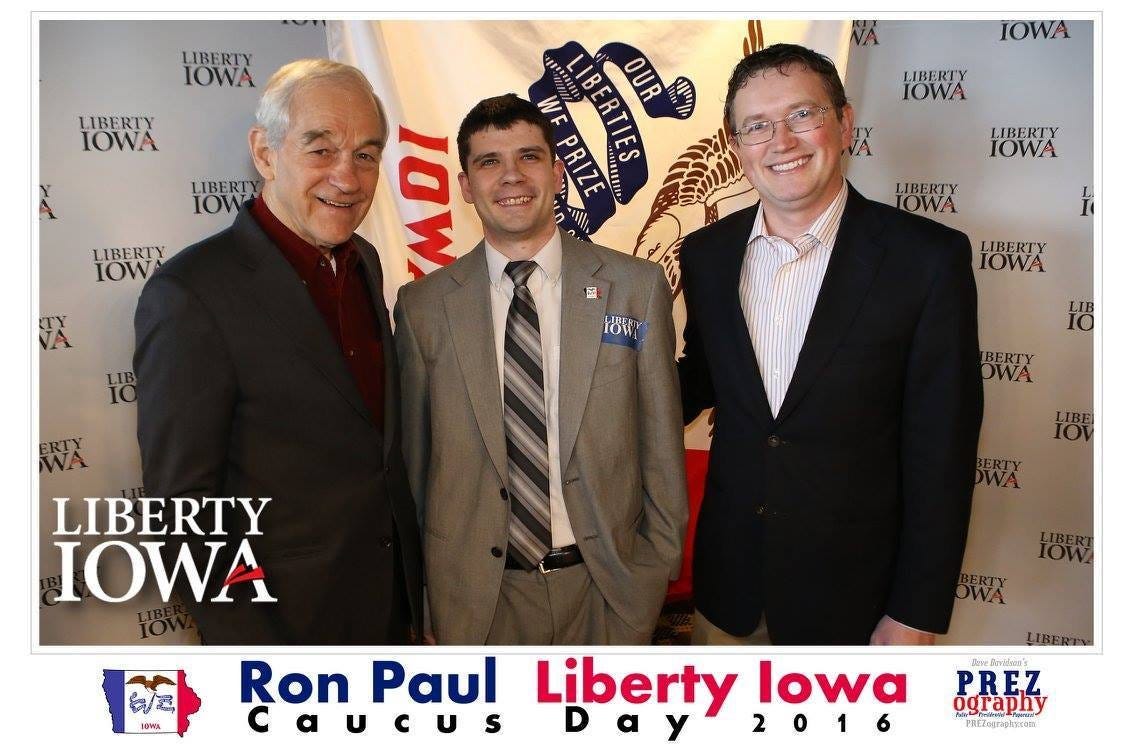
The author between Ron Paul and Thomas Massie at Liberty Iowa’s Caucus Day 2016.
This isn’t speculation about what could happen. It’s already being proposed in public, on X, by the founder of the Mises Caucus.
On May 28, 2026, Michael Heise proposed that the LP hold its presidential nomination open for Thomas Massie: use the February convention to pass bylaws changes allowing the party to back Massie if he won the GOP nomination, then recess the convention until roughly two weeks before the Republican convention, when Massie’s fate would be clearer.
Here’s a reason why sane libertarians shouldn’t 100% write off the Libertarian Party: Lets say hypothetically Massie were to seek the Republican nomination for president. Lets also say that in light of that, you wanted to hold the LP’s presidential nomination open to give it to…
His words: it would give Massie a “tremendous stick to wield and leverage, win or lose.” Read that again. The proposal is to turn the Libertarian Party’s presidential nomination into a bargaining chip for a Republican congressman’s primary campaign and for Heise to wreck havoc on the LP as he has for the past several years.
The Danger
While Heise says the delegates could recess the convention to a later date and endorse him if he wins, this opens up all kinds of potential problems. Don’t forget that the Mises Caucus initially opposed any online convention during Covid in 2020 and attempted to nominate no candidate in 2024 after their candidate lost the nomination. Nominating None of the Above would have cost the party ballot access in several states. Heise also endorsed Donald Trump ahead of the 2024 election.
He doesn’t care one bit about the party having a nominee or about the party maintaining ballot access. This would feed right into a power play that leaves the party with no nominee and no ballot access to show for it.
The delegates in El Paso won’t be picking a nominee for the race as it is. They’ll be betting on the race as it might become. We should remember the lesson of 2008 before February 2028.
Watch for parliamentary tricks and lawsuits to delay the convention and leave the party without a nominee in 2028. The 2024 Mises Caucus playbook to drop out and endorse the Republicans is still in play.

LP presidential candidates started being told: “Why are you running against Ron Paul?
Um… because both Paulists are girl-bullying mystical republicans?
The only states in which ballot access would be easier with a February convention (as opposed to a May convention) are Alabama, New Hampshire, New Jersey, Tennessee, Washington, and Wisconsin. This assumes we do get 3% for Massachusetts Auditor next month and that Question Three fails. It seems obvious we will get 3% in Massachusetts because we are in a 2-person race. This also assumes we do the party petition in North Dakota, which we always do in presidential years. States in which we are not ballot-qualified, but which have substitution and stand-ins, are Connecticut, Illinois, Iowa, Kentucky, New York, Ohio, Pennsylvania, and Virginia.
Not really easier for Alabama. Our ballot access laws and weird election laws regarding major parties make it absurdly difficult if not prohibitive, and the worst in the country.
Instead of trying to play the political mind games that the major parties play, the Libertarians should consider nominating someone who can make a strong intellectual and moral case for liberty. Maybe they should consider running someone from CATO, for instance.
Cato published a paper FOR gutting the Second Amendment to delete all citizen militias and leave the lone gunmen part as standalone. This in not seen through ends all constitutional protection for SDI and other protection against an international nuclear first strike. With friends like Cato, who needs Brutus?
“Ron Paul had good reasons for not endorsing Bob Barr. Bob Barr has a never really a libertarian.”
Who gets to conduct this purity test from now into eternity and who made them God? Asking for future reference when people try to pull the No True Scotsman fallacy. Donald Trump is not really a conservative or Republican to any definition of either that existed more than 10 years. Doesn’t matter to most of those groups, does it?
Those of us who were there know: BarrRoot was not libertarian. That’s why we supported Dr. Ruwart and Steve Kubby.
If you read Republican partisans out there, they en masse hate Thomas Massie. Catch some typical views from this site: http://www.rrhelections.com
Anyone that thinks Massie is winning a Republican presidential nomination is mistaken, sorry. That includes people that would work for him and donate to his campaign. The Republican Party in 2026 under Trump’s direction do not believe in anything libertarian except less taxes and tech/AI companies should have no limits on them.
Why on Earth should Libertarians care who the Republican or Democratic nominees are? I don’t view the Libertarian Party as a subset of either of the dominant parties. Just nominate a principled libertarian and forget trying to nominate a rejected “name” from the duopoly.
The reason why this matters is because I think it is fair to say that Rand Paul and Tom Massie both have pro-liberty records as elected officials. They have not run for or held political office as Libertarian Party candidates and members, but although they are Republicans they are the closest thing the Libertarian Party has to having elected Libertarian Party members in Congess.
Reality is that if Rand Paul and/or Tom Massie run for the Republican presidential nomination, a lot of dues paying Libertarian Party members, registered Libertarian Party voters (in the 30 states plus DC which have partisan voter registration) and small “l” libertarians will support them. If one or both of them runs for the Republican presidential nomination having the Libertarian National Convention in February will almost certainly cause a lot of logistical problems.
If it was only run of the mill Republicans that we were discussing then nobody in the Libertarian Party would care.
So I guess you are comfortable with the Libertarian Party being the minor league affiliate of the Republican Party. You would wait until Massie or Senator Paul are defeated for the GOP nomination and then welcome them in to the LP. The LP has done that before and the results have been suboptimal to say the least.
Lots of interesting stuff to cover here. I have had some similar thoughts about Rand Paul and/or Tom Massie running in the Republican presidential primary and having the Libertarian National Convention in February causing major problems. If the LNC had just left the convention to where it has been for years now this potential situation with Rand Paul and/or Tom Massie would be less of a logistical mess.
Ron Paul had good reasons for not endorsing Bob Barr. Bob Barr has a never really a libertarian. Barr either intentionally sabotaged the party or he was just using the party for ballot access, or both.
If Thomas Massie runs for president under the GOP, a February nominating convention would be a major mistake. In any situation, the LP should field a presidential candidate, but to do it before knowing the fate of libertarian aligned races of the major parties risks nominating a weak candidate, similar to Bob Barr. Ik it’s unlikely, but a good idea would be to compromise and move the convention to mid March to late April, when most of the important primaries have shown us a path for the duopoly’s likely picks; then we can nominate a good candidate to contrast themself from those options. I find it unlikely that Massie would run under the LP, but if he were to run on the GOP line, by March/April we would know if his primary race would sink or swim, if it sinks then the possibility of running as a Libertarian is more likely and a April convention would benefit everyone. If not, then at least we have the time to react and pick another candidate from within.
He’s not running. I obviously can’t know, but I know, know.
Convention Oversight Committee is moving forward with plans regardless.
We already know his primary race would sink. There is no way he would win the nomination, even if he wants it. His status among GOP voters is shown by how well he did in his last primary, with people who knew and had previously supported him.
I like Rand Paul and Tom Massie and J would support either of them running in the Republican presidential primary, but reality is that the Republican Party is way too corrupt to allow either of them to win and a lot of Republican Party rank and file voters are too brainwashed to vote for them anyway. If it looks like they will win the ruling establishment will cheat them out of winning and even if it looks like they will not win they will play dirty tricks to suppress their vote totals and influence.
There is still merit in either of them running because it will give them the opportunity to educate and inspire a lot of people with their message.
The Libertarian Party needs to be waiting in the wings with a good presidential ticket which can best capitolize on any momentum for liberty which Rand Paul or Tom Massie running in the Republican primary generates.
The Libertarian Party for the most part failed to effectively capitalize on the momentum for liberty which Ron Paul generated in 2008 and in 2012. Will it fail again if Rand Paul or Tom Massie runs in the Republican presidential primaries? I hope not and I will do whatever I can do to help the party not repeat past failures
It should be noted that the LP tried the early presidential nomination tactic in each election from 1976 to 1992, including with Ron Paul as the Libertarian presidential nominee in 1988, with little evidence of any advantage gained.
It’s the latest shiny thing. I opposed it.
Early conventions: More time to unite the Party behind the nominee; more time to fund raise; more time to build the local volunteer teams to actually campaign come September; more time for the actual candidate to visit states and get publicity and help with petition drives.
Late conventions: work when all the state and local parties are well organized, well funded, and there wasn’t a lot of contention over the nomination.
Not hard to determine which would work best in Party’s present situation.
Why do you think that a late convention would not be contentious?
Late conventions could be contentious and wouldn’t work. They work if not contentious- e.g. Rand Paul says he would run as Libertarian a year earlier and vast majority of the membership is ecstatic to support him.
The establishment parties have their conventions in the summer after the primary season which allows each candidate to build their campaign around those primary elections, fundraising, recruiting volunteers, visiting states, and generating publicity. Nominating a candidate earlier eliminates the ability to utilize any of those potential campaign activities, while failing to provide anything other than urgency-destroying time.
The two Libertarian presidential campaigns that received the highest vote totals, 2016 and 2020, were both held in late May and were contentious nominations. In my view the fact that in both of those races candidates were vigorously campaigning all the way through the casting of votes helped propel the nominee to better results than would have been obtained by nominating earlier and having that candidate spend months facing a calendar that gives little opportunity for campaign activity.
2016 was not contentious, it only went 2 rounds because Johnson fell 19 votes short of a majority in the first round.
2020 was more contentious, going 4 rounds, only because lunatics Kokesh and Vermin Supreme had enough support at just under 20% to hang around.
But they don’t top 2024, and hopefully, nothing in the future ever will.
The biggest advantage is with ballot access. There are some states where it would allow ballot access petition signature gathering to start earlier. It would not make a difference for ballot access in most states though.
Chris:
“. . . with little evidence of any advantage gained.”
In 1979, a year before the 1980 presidential election, Ed Clark received the Libertarian Party presidential nomination in Los Angeles. Ed Clark was on the ballot in all 50 states, Washington DC, and the US territory of Guam. This was the first time a third party candidate was on the ballot in all states eligible since the Progressive Party of Theodore Roosevelt in 1912. He received 921,128 votes 1.06% of the vote. This was a record that stood for 32 years.
His campaign and the Libertarian Party was covered by NBC News, ABC (Nightline), US News and World Report, Newsweek, National Review, The Progressive, New York Times, Los Angeles Times, Libertarian Review, Reason, The Nation, Hustler (an adult magazine founded by Larry Flint), Penthouse, McLane (a Canadian magazine), People, Playgirl, Next, The New Republic, AP, UPI, Fortune, High Times, and many other media.
Ed Clark received the endorsement of the Peoria Journal Star of Peoria, Illinois and four other newspapers (University of Texas, University of Oklahoma, and two other college newspapers). He participated in a presidential debate with Peoples Party candidate Barry Commoner (who was on the ballot in 29 states – a strong achievement made by an alternative party running a presidential candidate for the first time surpassing the Libertarian Party ballot access of two states who was running a presidential candidate for the first time in 1972).
At one time during the campaign a national polling organization had Ed Clark polling at 5% (Barry Commoner was polling at 1%).
The Ed Clark campaign aired 47 five minute commercials many in prime time television in the highest rated television programs. He aired many radio commercials including one in Spanish voiced by Alicia Clark, Ed Clarks wife. His campaign had a full page add in the New York Times. His campaign published nine position papers and four white papers covering the issues e.g., education, energy, taxes, foreign affairs, women’s rights. He published the campaign book A New Beginning. Ed Clark campaigned in 36 states, Vice Presidential candidate David Koch campaigned in 27 states, while Alicia Clark also campaigned in many states.
The facts I have just presented and there are more I could have presented is plenty of evidence the right presidential candidate can take advantage of an early nomination and that a successful campaign can be done.
Actually, the essay you just presented only provides “plenty of evidence” that a Presidential candidate who picks a millionaire as his running mate can fund all sorts of things that the usual candidate can’t, that getting one newspaper endorsement (not counting college kids’ publications) is merely *one* newspaper endorsement, and that multiple porn magazines covering the Clark campaign isn’t necessarily a good thing.
College newspapers matter a great deal. They influence people who are in the process of becoming voters. I see no reason to suppose that serious coverage in gentlemen’s magazines is not positive. In addition, college newspapers will cover Libertarian Presidential nominating campaigns, as my 2008 nominating campaign demonstrated, while traditional newspapers will not.
Adamson:
Ed Clark campaigned at many colleges because his campaign planned to target young people. And where do you find young people, at colleges. Also, college newspapers are not kids’ publications. They are serious newspapers some which have one Pulitzer Prizes e.g., Contra Costa, Texas A&M, University of Virginia, Virginia Tech, Biola, University of Iowa. And, how many Libertarian Party presidential candidates have received the endorsement of five newspapers?
Media coverage by adult gentlemen’s magazines, of course there might be some a candidate might want to avoid, are a positive. By the way Playgirl which did an article on the Ed Clark campaign was an adult women’s magazine. And who better to target are readers of adult magazines who over the years attempts have been made by government to prevent these magazines from being published.
As to ballot access Ed Clark’s campaign made a commitment in early 1980 that they would do everything in their power to get Ed Clark on the ballot in all 50 states (As novelist Nora Roberts has said, “If you don’t go after what you want, you’ll never have it. “). Did our last presidential candidate’s campaign make a commitment to do everything in their power to get Chase on the ballot in all 50 states? The obvious answer has to be no. That Chase did not make it on the ballot in New York might be excused because it is hard to get on the ballot in New York (but remember Ed Clark was on the ballot in New York), but how is not getting on the ballot in Tennessee and Guam where it is very, very easy to get on the ballot excused?
Since 1980 New York ballot appearance has become much more challenging for third party Presidential candidates. Tennessee was supposed to be a sure thing for a ballot appearance, but then it wasn’t.
I second that. As a pro-nuclear agitator I avidly read campus papers to see whwhich scheduled meetings anti-energy and surrender advocates planned to infiltrate. I would then show up myself to ask awkward questions. That was how I discovered the Libertarian Party and Michael Grossberg.
Thanks, Jose, for providing that reminder of history. I also recall the momentous Ed Clark campaign. I helped gather signatures in Southeastern Virginia that enabled Mr. Clark to be on the Virginia ballot and recruited a distinguished local person to be the candidate for Presidential elector for the 4th District of Virginia. I put up a poster on an empty billboard on a nearby highway and passed out Ed Clark for President brochures to households in my neighborhood. It was important that Ed Clark had a sufficient time to gather and mobilize resources for his successful campaign. Thanks also to his running mate, David Koch, for significant and generous funding of the campaign.
A quick search at newspapers.com informs me that from Sept. 9, 1979 when Clark was nominated through July 9, 1980 just a few days before the Republican National Convention the search term “Ed Clark” generates 3,996 hits. For the period of Aug. 15, 1980(a few days after the Democrats renominated Carter) through Nov. 15, 1980 the search term “Ed Clark” generates 13,891 hits.
The Clark campaign was a high-water mark for over thirty years. Nevertheless, the vote totals were viewed at the time as disappointing. Clark was a great candidate, had done very well in the 1978 California gubernatorial campaign, and had all that Koch money to work with, but still couldn’t reach a million votes. If starting early were such an advantage, why didn’t Clark do better overall and why didn’t he beat Anderson in any state other than Alaska(where the LP was in the state legislature) when Anderson did not begin his Independent campaign until after April 24th?
If the Clark campaign did benefit from the early nomination, explain how they benefitted. Declaring any and every thing accomplished by the campaign as due to the early nomination is unsupportable considering the other advantages they had. This is especially so when similar early nominations of Roger MacBride, David Bergland, Ron Paul, and Andre Marrou led to quite poor showings. If significant benefits of the early nomination cannot be specifically detailed the only reasonable conclusion must be that they do not exist.
Other than for reasons of ballot access I agree with you. Just nominate a libertarian (NOT a left-libertarian NOR or right-libertarian) and let the ideas do the work.
Campaigning in 1980 was far different than today—the swings were different, there was no Internet, a lot more gumshoeing, and more of a challenge to do local advertising and national exposure all at once. That factors in.
The Libertarians should nominate a pro free trade candidate, and see if that will steer Paul or Massie away from Republican protectionism.
Right on the money, Walter. No more playing into the hands of Mises Caucus which is the “right flank’ of the enemy as some jackasses on Faketarians are their “left flank”. Same enemy putting the context not only pre Ayn Rand, but pre Edgar Ansel Mowrer back to the “good ole days” of a world lit only by fire. If Granite State Libertarian Party and the LNC can get rid of these fifth columnists (who pose with Ayotte, Osborne, the book burning bitches-also known deceptively as Moms For Liberty) then it behooves the Libertarian Party in its entirety not to fall for their rot. It is Libertarian pressure and hard pressure from the outside that the duopoly fears and it should be maximized!